Anna B. Mahawe
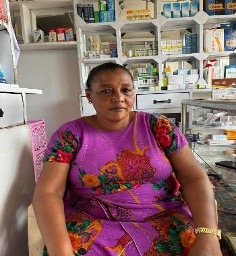
Anna Mahawe is 47 years old and married woman with one child. She owns two Upendo Essential Medicines Store, one at Vingunguti and another one in Tabata Dar es Salaam. Anna is among the women who attended WSP training on strengthening women-owned businesses through public procurement in Tanzania. She had this to say about continuing using the knowledge she gained from the training
“I engaged with the training and gained a clear understanding, which allowed me to open my second store. I continue to apply that training to further enhance my business. The training enhanced my skills and understanding, allowing me to expand my business. …………I focused on the training skills we received, particularly the importance of reducing expenses to increase savings”.
…”I learned that to succeed in my business, I must reduce unnecessary expenses. For instance, if I earn a profit of TSH 10,000, I should not spend more than TSH 5,000 to sustain the business.
“As a woman, the training has helped me enhance my knowledge in running my business”. “I would greatly appreciate it if WSP and the government could provide additional capital to help me advance beyond my current situation”.
(Anna Mahawe, WOSMEs training participant-Ilala Dar es salaam)
What has changed: Anna B. Mahawe has expanded her business by opening a second “Upendo Essential Medicines Store”. She has also significantly reduced her household expenses, lowering them from TSH 600,000 to between TSH 400,000 and TSH 450,000 per month. This change is attributed to her increased understanding of the importance of reducing expenses to increase savings as a result of the financial skills and management training she received.
Why is this important: The changes are important because they demonstrate an improvement in Anna’s business management skills and personal financial management. The expansion of her business indicates growth and potential for increased income and stability. The reduction in household expenses shows a greater awareness of financial discipline, which can lead to increased savings and capital for her business. For women-owned businesses in Tanzania, such improvements contribute to their strengthening and overall economic empowerment.
What contributed to the change: The primary contributor to the change was the training Anna received from WSP on strengthening women-owned businesses through public procurement. Specifically, she credits the training with enhancing her skills and understanding, which allowed her to expand her business and focus on reducing expenses to increase savings.
What lessons can we learn from this: Several lessons can be learned:
Targeted training can lead to tangible business improvements: Anna’s ability to expand her business and manage finances better highlights the direct impact of relevant training.
Financial literacy is crucial: The emphasis on reducing expenses and increasing savings is a key takeaway for business sustainability, particularly for small business owners.
Follow-up and additional support may be necessary: Despite the positive changes, the impression that Anna needs extra support and retraining regarding the National e-Procurement System suggests that initial training might not always be sufficient for complete adoption of all concepts, and ongoing support can be beneficial for deeper engagement with all aspects of the training.
Capital access remains a barrier: Anna’s request for additional capital indicates that even with improved management, access to funding is still a critical need for business advancement for women entrepreneurs.
Understanding individual retention of information: The observation that Anna didn’t remember aspects of the NEST practical training suggests that training methodologies or follow-up might need to be adapted to ensure better retention and application of all learned material, especially complex systems like e-procurement.
Conclusion
The case of Anna’s business highlights that targeted training, while effective in enhancing financial literacy and business management, requires ongoing support and access to capital to fully empower women entrepreneurs. Despite tangible improvements in business expansion and financial management, barriers such as limited capital access and incomplete retention of complex systems like the National e-Procurement System (NeST) underscore the need for continuous, tailored interventions to ensure sustainable growth.
Recommendations
- Implement Ongoing Support and Follow-Up Training
To maximize the impact of the WOSME training programs, continuous support and periodic retraining should be provided to strengthen understanding of the complex concepts to foster and mastering digital procurement systems (such as NeST) and procurement tenders/contracts or call for proposals platforms. This ensures better retention and application of knowledge.
“I would greatly appreciate it if WSP and the government could provide additional or follow-up training to continuously assist women owners of business”
This reflects Anna’s need for further assistance, suggesting that follow-up support could address gaps in understanding, application and access to digital procurement systems and devices.
- Facilitate Access to Capital for Women Entrepreneurs
It is strongly recommended that, the forthcoming programs should integrate mechanisms to provide or link women entrepreneurs with accessible funding opportunities to overcome financial barriers and support business growth.
“I would greatly appreciate it if WSP and the government could provide additional capital to help me advance beyond my current situation.”